


Academic Experts
Academic Experts
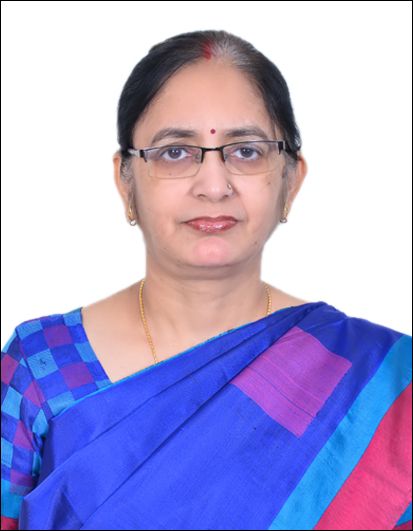
Prof. Alka Tripathi
DEAN ACADEMICS
alka.choubey@jiit.ac.in
Biography

Prof. Alka Tripathi is a distinguished academician and researcher, currently appointed as the Dean Academics UG at the Wish Town Campus, Jaypee Institute of Information Technology (JIIT). Prior to this, she served as Professor and Head of the Department of Mathematics at the Jaypee Institute of Information Technology (JIIT), Noida. She joined JIIT in 2001. She earned her Ph.D. in Mathematics from Banaras Hindu University in 1995, following her M.Sc. from the same institution. With over 30 years of teaching and research experience, Prof. Tripathi has made significant contributions to both academia and research. Her leadership at JIIT has strengthened the department’s research profile and inspired many young researchers to pursue advanced studies in mathematics and computational intelligence.In addition to her academic roles, Prof. Tripathi is involved in preparing the university's timetable, implementing Outcome-Based Education, and mentoring process.

Research Highlights

Her primary research interests span Categorical Fuzzy Topology, Fuzzy Automata, Rough Sets, Rough Topology, Rough Automata Theory, Special Functions, Probability Theory, and Random Processes. She has an impressive publication record, including numerous research papers in reputed international journals. Her work often integrates fuzzy set theory into practical computational applications, such as compiler design, approximate string matching, and grammar generation. Prof. Tripathi has guided eight Ph.D. thesis (two as administrative supervisor), and is currently supervising two more, alongside mentoring several postgraduate dissertations.

Areas Of Interest
  • Categorical Fuzzy Topology
  • Fuzzy Automata
  • Fuzzy Topology
  • Rough Set Theory
  • Rough Topology
  • Rough Approximations
  • Decision Making
Publications
  1. Kaur R., Tripathi A., “Dynamic state general fuzzy automata under semantically similar environment: An application-based study on air pollution for smart cities 4.0”, New Mathematics and Natural Computation, 2025. [Indexed in: ESCI, SCOPUS, Impact Factor:1.1, H-Index: 20, Publisher: World Scientific, Q3]
  2. Kaur R., Tripathi A., “Hybrid model of general fuzzy automata and semantic computing: An application to transportation e-service”, Soft Computing, vol. 28, pp. 10519–10530, 2024. [Indexed in: SCIE, SCOPUS, Impact Factor:3.2, H-Index: 120, Publisher: Springer, Q2]
  3. Kaur, R., and Tripathi, A., “Statistical analysis of lexemes generated in ‘C’programming using fuzzy automation: An Empirical approach to NextGen Software”, Journal of Intelligent and Fuzzy Systems, 46(1), pp. 2537-2546, 2024. [Indexed in: SCIE,SCOPUS, Impact Factor: 1.2, H-Index: 89, Publisher: IOS Press, Q2]
  4. Tripathi A. and P. Madan, “Decision Making Based on Rough Approximations Generalized by j-Fuzzy Neighborhoods”, Journal of Intelligent and Fuzzy Systems, vol. 48, issue 3, pp. 1-11, 2024, Doi: 10.3233/JIFS-239107. [Indexed in: SCIE, SCOPUS, Impact Factor: 1.2, H-Index: 89, Publisher: IOS Press, Q2]
  5. Priti and A. Tripathi, "Fuzzy Approximation based on τ −R- Fuzzy Open (Closed) sets", Mathematical Foundations of Computing, vol. 6, no. 3, pp. 558-572, 2023, doi:10.3934/mfc.2023010. [Indexed in: SCOPUS, ESCI, Impact Factor: 0.8, H-Index: 11, Publisher: American Institute of Mathematical Sciences, Q2]