

Academic Experts
Academic Experts
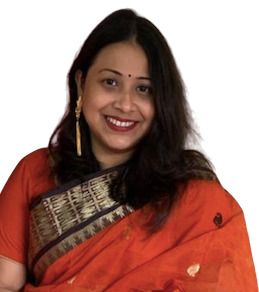
Dr. Mohua Dutta
Assistant Professor(Grade I)
mohua.dutta@jiit.ac.in
Biography

Dr. Mohua Dutta is an Assistant Professor of English in the Department of Humanities and Social Sciences at Jaypee Institute of Information Technology (JIIT), Noida. She is an accomplished academic with a research specialization in Migration Studies. She earned her Ph.D. in English Literature from the Department of Humanities and Social Sciences, IIT Kanpur, where her doctoral work explored historically overlooked patterns of internal migration in India through the intersecting lenses of class, caste, and gender. Dr. Dutta holds Bachelor’s, Master’s, and M.Phil. degrees from the University of Delhi. Her M.Phil. research focused on the evolution of Indian graphic narratives, offering a comparative study from early comics to contemporary graphic novels. Prior to joining JIIT, she taught at Amity University Gurgaon for nearly three years, where she also served as the Academic Programme Coordinator for the B.A. (H) English and M.A. English programmes. During her doctoral studies, she served as a Student Tutor at IIT Kanpur and as a Teaching Assistant for an NPTEL/SWAYAM course on Postcolonial Literature. Her scholarly contributions include presentations at numerous national and international conferences and publications in peer-reviewed journals. Her interdisciplinary research interests continue to engage with questions of identity, displacement, and representation within postcolonial and cultural studies frameworks.

Research Highlights

My primary research area is Migration Studies, with a focus on the underexplored literary representations of internal migration in India. While Indian English Literature has largely focused on international migration and diasporic experiences—typically urban, middle-class, English-educated immigrants—this leaves a significant gap in scholarship on internal migration. My doctoral study addresses this gap by foregrounding how internal migration appears as a recurring yet overlooked theme in post-independence Indian English novels. Using an intersectional lens of class, caste, and gender, my research analyzed four novels: Anita Desai’s Cry, the Peacock (1963), Upamanyu Chatterjee’s English, August (1988), Rohinton Mistry’s A Fine Balance (1995), and Aravind Adiga’s The White Tiger (2008). These texts reflect diverse migratory patterns: rural-to-urban migration for work, caste-based displacement, urban-to-rural relocations for government employees, and marriage-related migration. My study examined four key aspects: push factors from origin areas, pull factors at destinations, the socio-economic links between them, and migrant aspirations. However, I argued that these alone are insufficient. The fulfillment—or lack thereof—of migration’s promised outcomes is crucial, especially since many migrations are distressed, permanent or recurring, and intergenerational. Thus, I explored how structural forces often constrain the realization of migratory hopes. I aim to further develop this work into a monograph, incorporating topics such as associational child migration, displacement due to conflict or development, and the mass internal migration during the COVID-19 pandemic.

Areas Of Interest
  • Migration and Mobility Studies
  • Comics & Graphic Novels
  • Postcolonial Literature
  • Indian English Literature
  • Popular Literature
Publications
  1. M. Dutta and S. Chattopadhyay, “Impact of Urban Migration on Caste: Rohinton Mistry’s A Fine Balance and Rural-to-Urban Caste Migration in India,” Contemporary Voice of Dalit, May 26, 2024. [Online]. Available: https://doi.org/10.1177/2455328X241245887
  2. M. Dutta, “The Journey from ‘Darkness’ to ‘Light’: Aravind Adiga’s The White Tiger and the Phenomenon of Rural to Urban Internal Migration in India,” Journal of Migration Affairs, vol. 4, no. 2, pp. 89–105, Mar. 2022. [Online]. Available: https://doi.org/10.36931/jma.2022.4.2.89-105
  3. M. Dutta and S. Chattopadhyay, “Midnight’s Children as a Superhero Novel: Contesting the Politics of Superheroes and Supervillains,” Storyworlds: A Journal of Narrative Studies, vol. 12, no. 1–2, pp. 79–103, Summer–Winter 2020. [Online]. Available: https://doi.org/10.1353/stw.2020.a902752